I only needed five lines of copy.
This is not ideal when the thing you are explaining turns out not to be a dish so much as a visible endpoint of a fairly deranged twentieth-century drama: Gandhi’s food reform, American soybean breeding, Indian agricultural universities, yellow mosaic virus, edible-oil shortages, extruder cookers, and roadside vendors figuring out how to make industrially processed soy behave like tandoori meat.
Obviously, none of that fits on a menu.
We had Indian food at our wedding reception, and for the menus we wanted each dish to carry a bit of the world that created it. Some dishes resolved cleanly into a few vivid images. Pav bhaji gave me Portuguese bread, Bombay mill workers, butter, spice, and a metropolis feeding itself in a hurry.
Soya chaap did not.
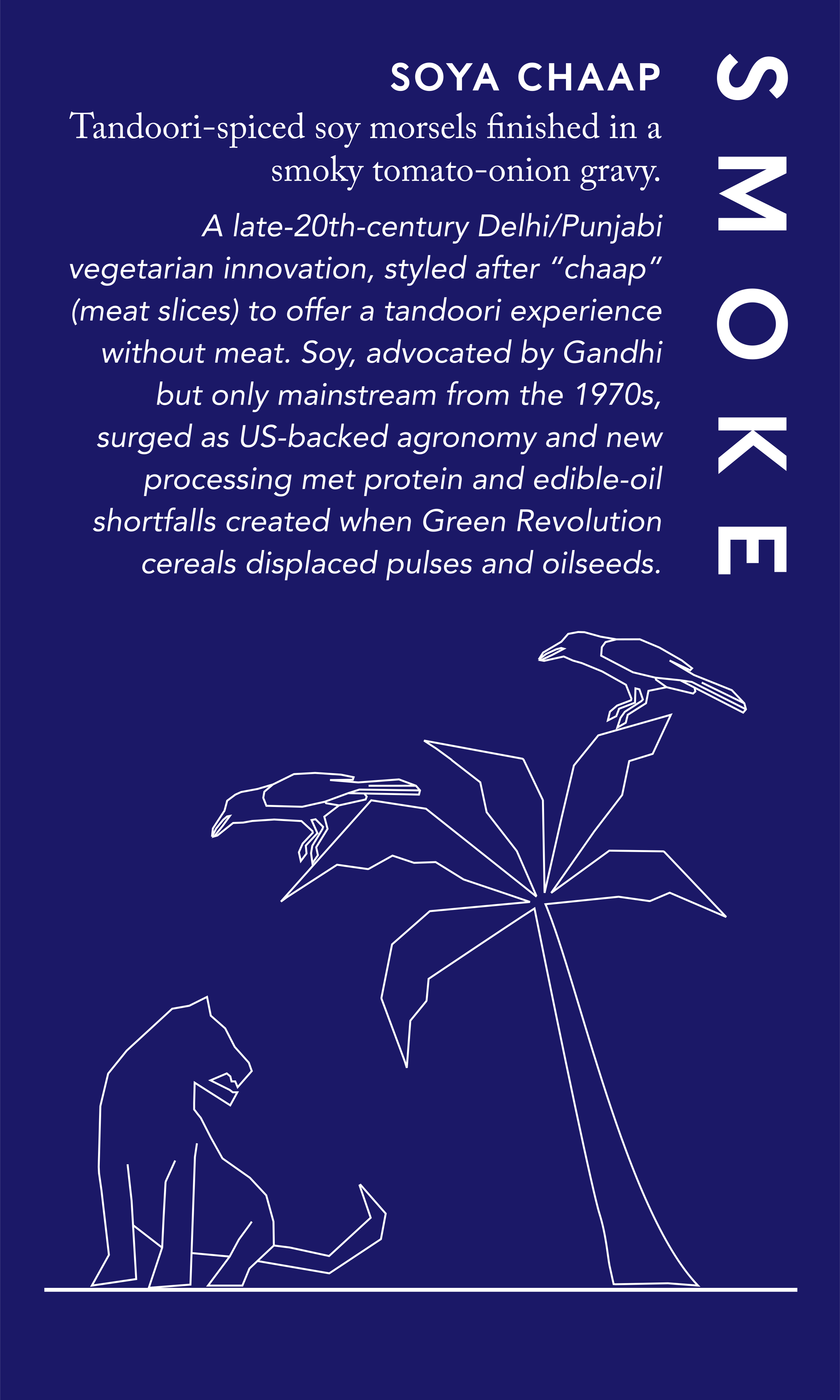
The menu eventually read:
Soya Chaap
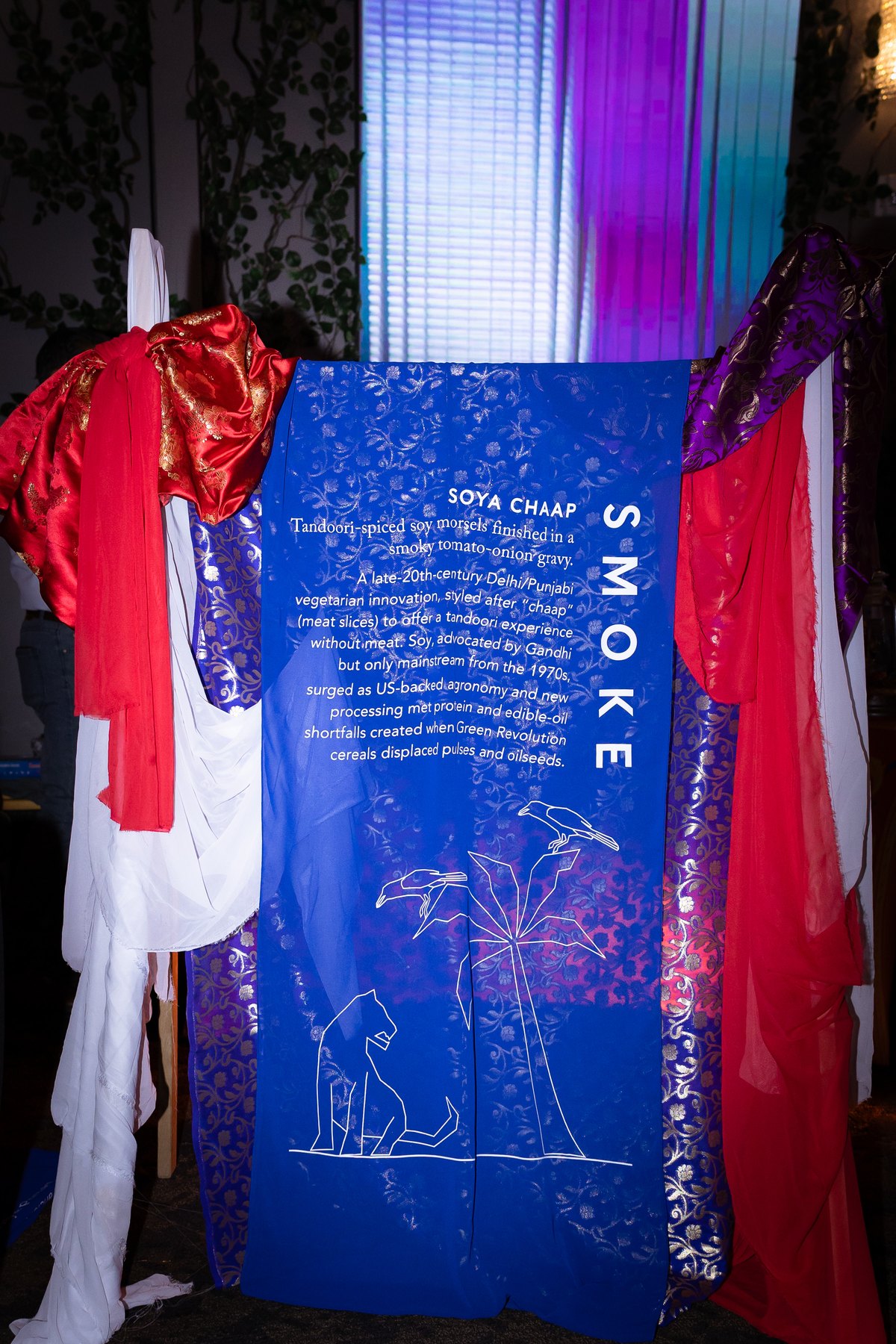
Tandoori-spiced soy morsels finished in a smoky tomato-onion gravy.A late-20th-century Delhi/Punjabi vegetarian innovation, styled after “chaap” — meat slices — to offer a tandoori experience without meat. Soy, advocated by Gandhi but only mainstream from the 1970s, surged as US-backed agronomy and new processing met protein and edible-oil shortfalls created when Green Revolution cereals displaced pulses and oilseeds.
As food, soya chaap is easy enough to describe. It is a modern North Indian vegetarian dish, especially associated with Delhi and Punjabi cooking. Soy protein or soy flour bound with wheat gluten or maida, shaped into chewy morsels or wrapped around sticks, then cooked in the grammar of tandoori food: marinade, smoke, char, tomato-onion gravy. It fills the sensory and social role of chaap without the meat.
The harder question was why processed soy had entered Indian food in this form. Years earlier, my Tamil mother-in-law introduced me to soya chunks, and the thing that stuck with me was not exactly the taste but the ontology. What was this stuff?
It was not tofu, tempeh, miso, or a whole bean worked into an old household recipe. It was industrially produced textured vegetable protein: dried, extruded, rehydrated into a masala sponge.
Why had I seen soy in Indian food like this, but not as soybeans? India has one of the world’s longest and most elaborate vegetarian food cultures. East Asia, and parts of Southeast Asia, have ancient soy traditions. Geographically, culinarily, and nutritionally, soybean seems like it should have had an obvious path into Indian cooking. But in mainstream Indian food, soy is an upstart.
It’s not that soybean was totally absent from India. That would make a cleaner story, but it is not quite true. Soybean reached parts of the subcontinent centuries ago over the Himalayas and through Burma, and was traditionally grown in small pockets in places like Himachal Pradesh, eastern Bengal, and highland parts of central India. It even had local names: bhatmas, ramkulthi, garakalay, kalitur. And yet it remained marginal. It never became a staple. It never became a dal like chana, mung, urad, masoor, and toor, or a household fat in the way ghee, mustard oil, sesame oil, or coconut did.
So the question was not “why didn’t India have soy?” but “why didn’t soy become Indian food?”
India did not lack vegetarian protein. It had legumes, dairy, nuts, grains, and a thousand ways to prepare them. But a plant is more than a nutrient profile. It is a crop, a cooking time, a texture, a fuel requirement, a storage strategy, a ritual category, and a set of inherited expectations. Soy was rich in protein and oil, but that did not automatically make it food.
To explain the skewer, we had to leave it behind: first for Gandhi’s kitchen, then for wheat fields, seed libraries, oil mills, and extruder cookers.
Food Reform
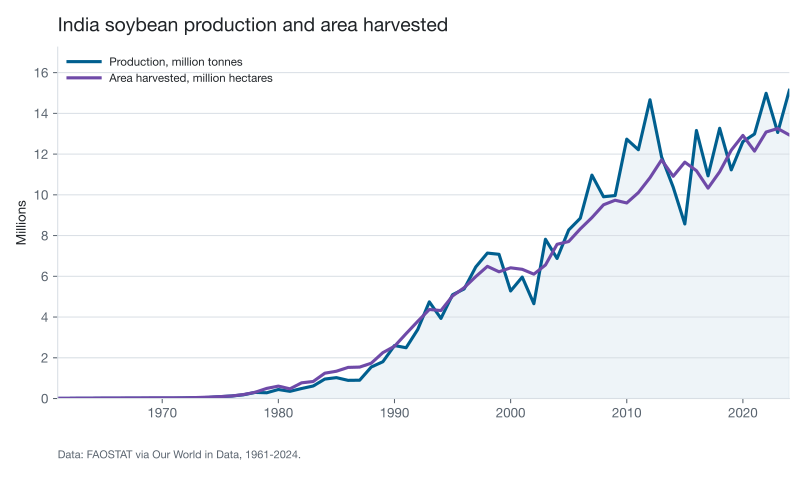
Gandhi was one of soybean’s earliest modern Indian champions, which is less surprising once you remember how much of his politics passed through food. For him, diet was not a private matter of preference. Food was where ethics, economics, self-rule, bodily discipline, and village welfare intersected. Still, the chronology is worth pausing over: Gandhi was advocating for soy in the 1930s, roughly four decades before soybean cultivation actually took off in India.
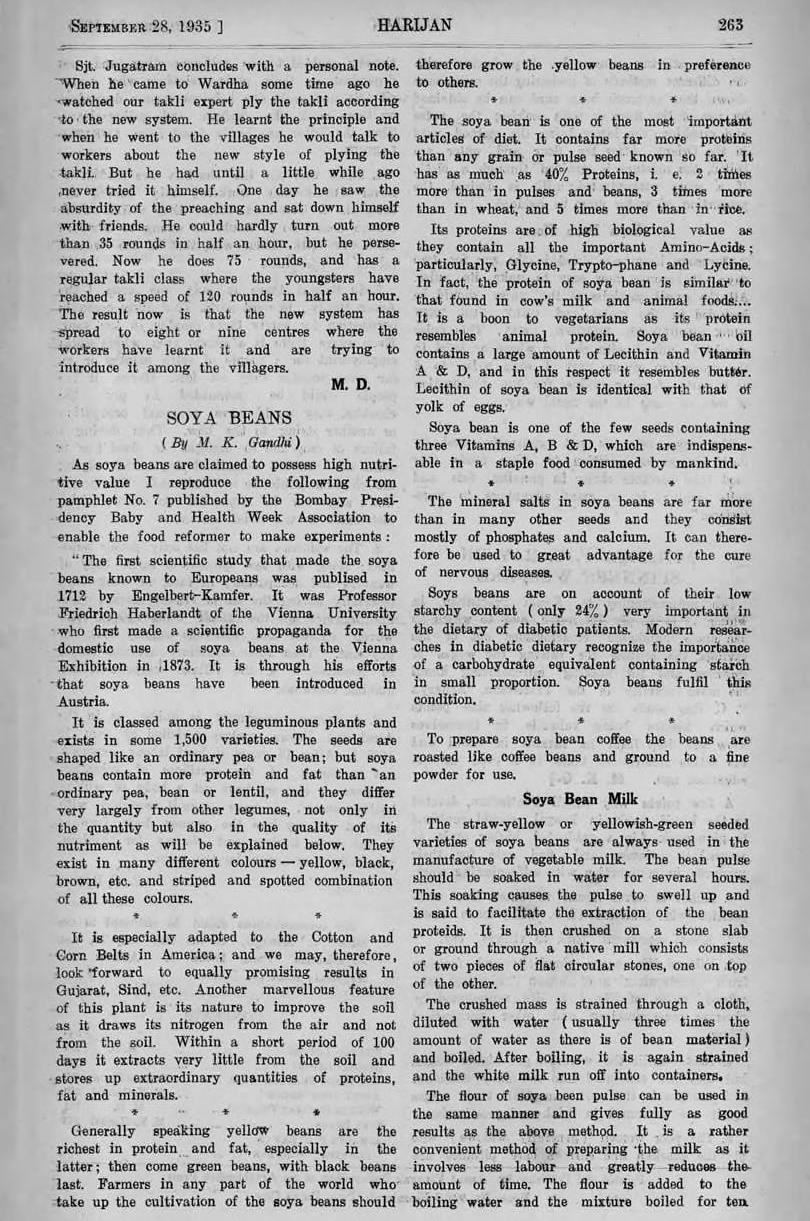
In 1935, writing in Harijan, he described Narhar Bhave living largely on milk and six ounces of soybeans, and noted that the ashram inmates of Maganwadi, Gandhi included, had begun experimenting with them. The argument was quintessential Gandhi: nutrition, thrift, and village uplift concentrated on a single bean. He framed the experiment as “food reform from the poor man’s point of view,” then enthusiastically dug into the arithmetic. Soybean had more protein and fat than gram, wheat, or eggs; therefore, he warned, one should not simply add it on top of an ordinary diet. Wheat and ghee should be reduced, and dal could be omitted, because soybean was itself “a highly nutritious dal.”
There’s something charming and brutal about this kind of nutritional reasoning. The body needs protein; soybean has protein; therefore soybean should be eaten. But food systems cannot be reduced to arithmetic alone.
Gandhi’s own cooking instructions reveal part of the problem. He tells readers to soak the beans for twelve to eighteen hours, then cook them, noting that at Maganwadi they steamed them for two hours. In a nutritional table, this is irrelevant. In a household, it is everything. Two hours of steaming is fuel, attention, timing, and labor.
Early promotion efforts ran into exactly these constraints. People tried to cook soybeans like dal, but soybeans did not behave like dal. They took much longer to cook, did not disintegrate into the same texture, and had a beany flavor people did not know how to place.
And let’s be clear: “takes longer” is a serious domestic-economic problem. Longer cooking means more time taken from other forms of work and, often more importantly, more fuel. Fuel has to be bought, gathered, stored, rationed, carried, or conserved. In a rural household it might mean firewood, dung cakes, or charcoal; in an urban household it might mean coal, kerosene, LPG, or electricity, each with its own cost and scarcity. A bean that needs more fuel and time is making a serious claim on the household economy.
Simply put, soybeans were nutritionally persuasive and culinarily awkward. They had the wrong cooking behavior, the wrong texture, no inherited habits around them, and no strong market waiting for farmers who chose to grow them. Earlier twentieth-century agricultural researchers had made repeated attempts to evaluate and improve soybean for Indian conditions, from Delhi to Madhya Pradesh to Tamil Nadu, but the crop stayed marginal. The barriers were painfully practical: weak cultivation knowledge, weak markets, no high-yielding varieties, no familiar cooking practice, and no oil or processing industry to create demand.
If advocacy were enough, Gandhi’s soybean push would have worked. It did not.
But the problem Gandhi was trying to solve did not go away. If anything, post-independence India made the question sharper: how do you feed a huge, growing, largely poor population not just enough calories, but enough protein and fat?
The Green Revolution and its Consequences
The Green Revolution answered one version of that question spectacularly well. In the simplified schoolbook version, it means high-yielding wheat and rice varieties, Norman Borlaug, fertilizer, irrigation, state procurement, and India moving away from the constant threat of famine. That version is true enough, but incomplete. The Green Revolution was a massive achievement in caloric security, especially through wheat and rice. But it also made Indian agriculture more cereal-centered, as land, credit, irrigation, procurement, and farmer incentives increasingly favored crops that could produce more grain and more money under the new regime.
That had consequences for pulses and oilseeds. Pulses had long been central to Indian diets, especially vegetarian diets, but they did not receive the same technological and policy momentum as wheat and rice. A 1977 study of six major wheat-growing states found that 22% of the post-1964/65 expansion in wheat acreage could be accounted for by reduction in pulse area. The same study also found that high-yielding wheat increased total foodgrain and nutritional output overall, which highlights the tradeoff. The Green Revolution solved one class of problems while worsening or exposing another: India became much better at producing calories, but the older balance of cereals, pulses, and edible oils was fraying.
This is where soybean re-enters the story. Not as Gandhi’s household dal substitute, but as something more industrially useful: a protein crop, an oilseed, and a potential monsoon crop that could fit into real farming systems. India needed edible oil, farmers needed profitable crops, and processors needed raw material. Soybean suddenly looked like it might answer several problems at once.
Instead of asking, “Can Indian households be persuaded to cook whole soybeans?” researchers, breeders, processors, and policy people began asking, “Can soy be made useful inside Indian agriculture and industry?”
Crop Science
Before soybean could become soya chunks or chaap, it had to become a dependable crop. That meant test plots, disease resistance, viable seed, processing capacity, and institutions capable of linking breeders, farmers, and industry.
The best account I found of this early push comes from B. B. Singh, a legume breeder who writes about the Pantnagar program partly as technical history and partly as participant memoir. In the 1960s, India was building agricultural universities modeled partly on the American land-grant system. Two mattered especially here: Pantnagar, one of the flagship institutions, and Jabalpur, whose central Indian hinterland would later become soybean country.
Singh’s work on soybean was specifically motivated by the protein problem. At Illinois, he chose legumes because cereals already had large, well-funded efforts, and because India’s vegetarian population needed better protein sources. The legume available to him there was soybean.
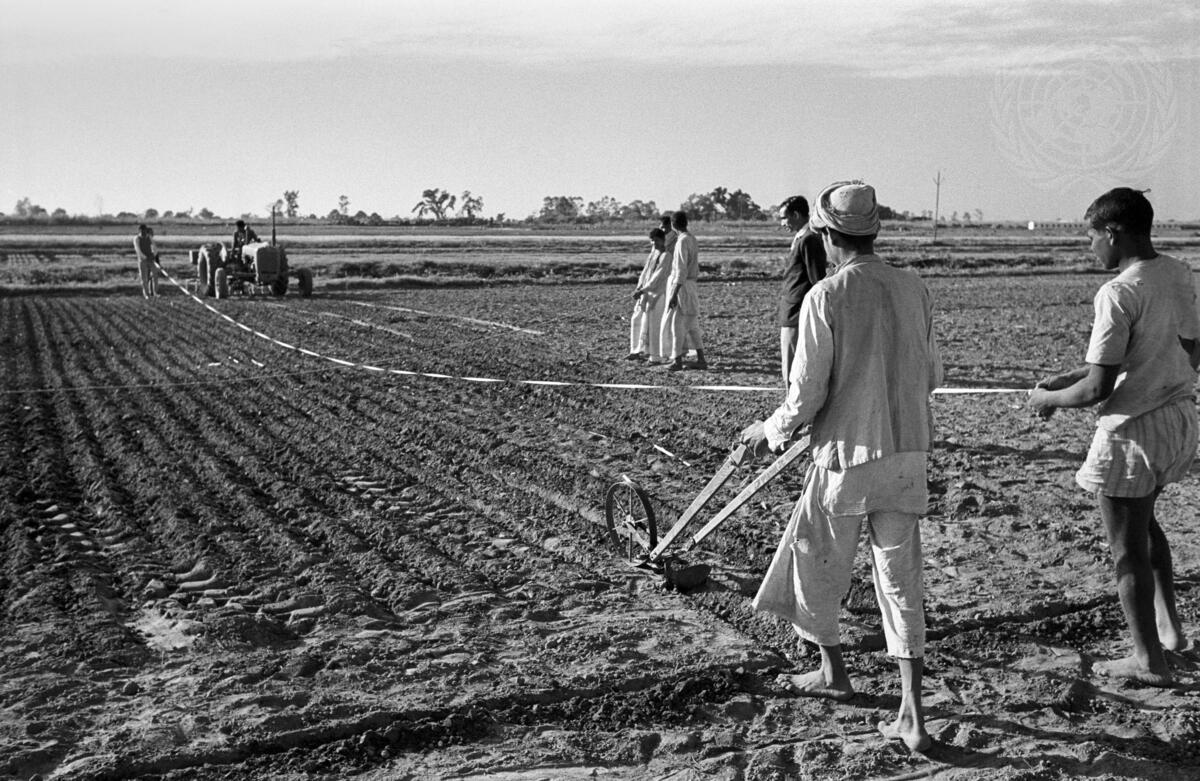
The American role is one of the stranger parts of the story. India and the United States were not exactly natural partners in this period. India was officially non-aligned, often closer to the Soviet Union in strategic terms, and US-India relations ranged from chilly to openly strained. But agriculture could still move through the cracks. Seeds, field trials, plant pathology, university partnerships, processing technology: small technical things passing through large geopolitical tensions. Food insecurity can create its own practical diplomacy.
At Pantnagar and Jabalpur, Indian researchers worked with the University of Illinois, but they were not trying to transplant the classic Midwestern soybean to India. The useful leads came from the American South. Varieties like Bragg and Hardee had already been bred closer to the problem India actually faced: heat, humidity, disease pressure, and a growing season shaped by monsoon rains. They were not Indian soybeans, exactly, but they were much closer than Iowa soybeans.
The early results were spectacular enough to change the crop’s status almost immediately. In 1965–66, preliminary trials using varieties such as Bragg and Hardee yielded 3 to 4 tonnes per hectare in 110–130 days, roughly 3–4 times the average yields of pulses like mung bean, black gram, and pigeon pea. After decades of soybean being nutritionally compelling but agriculturally marginal, suddenly it looked like a serious crop.
That was enough for ICAR, the Indian Council of Agricultural Research, to launch the All-India Coordinated Research Project on Soybean in 1967, with major centers at Pantnagar, Jabalpur, and Delhi and sub-centers across the country.
The trial yields made soybean look newly plausible, but field performance was only the beginning. To become a crop at scale, soybean still needed disease resistance, viable seed, farmer confidence, markets, and processing demand.
And even with all that effort, the first commercial push nearly failed.
A Pestilence in the Fields
Bragg, a soybean variety from Mississippi, was released for general cultivation in 1968. Seed was imported and multiplied, and the first commercial crop was grown by farmers in 1970. Then reality arrived all at once.
The problem wasn’t a single failure; the whole stack was weak. Bragg seed produced in India did not germinate reliably in farmers’ fields. Yellow mosaic virus, previously mainly a mung bean problem, became a serious threat to soybean harvests. Severe rust appeared. Farmers who did manage to harvest had no reliable market for the crop.
Critics, in Singh’s phrase, “overemphasized anti-nutritional factors” and warned that soybean would compete with other food crops in an already precarious system. ICAR even warned the Pantnagar soybean coordinator that if yellow mosaic, rust, and other production problems were not solved soon, the project might be phased out.
The rescue came from a seed library.
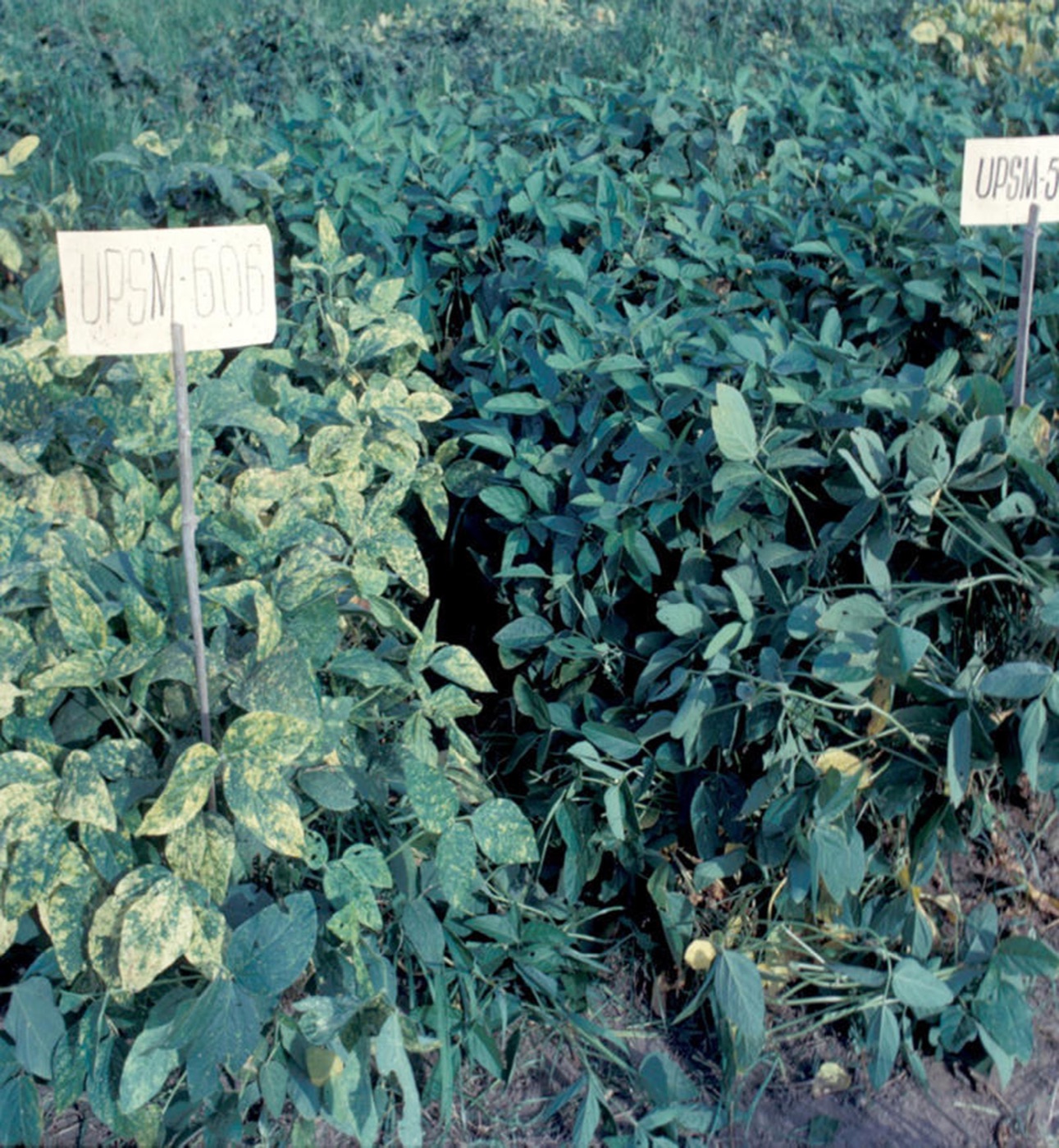
Pantnagar’s breeding program screened about 1,400 available germplasm lines and found none resistant enough. USAID advisors were then asked to help arrange import of the world soybean germplasm collection maintained by the USDA. Even the advisors were not sure the USDA would donate the whole collection, but Singh had trained at Illinois and was able to make personal appeals to soybean scientists at the University of Illinois and Stoneville, Mississippi. Those appeals were answered when about 3,500 lines were sent to India through USAID.
After quarantine, they screened 3,047 lines over the course of 1971 and 1972. Only two were completely resistant to yellow mosaic. Six Japanese lines were resistant to rust. Those lines became the basis for breeding Indian varieties that combined disease resistance, yield, and seed viability.
This is not a romantic version of agricultural history, but it is the part I find most compelling. The eventual Indian soybean boom depended on Chinese and Japanese germplasm preserved by the USDA, American soybean scientists willing to send it, USAID channels to move it, Indian plant quarantine, Pantnagar breeders screening thousands of lines, and Indian agricultural institutions turning resistance genes into usable varieties. The food on the plate depends on invisible libraries of seeds.
Disease resistance was not the only hidden problem. Seed viability had its own drama. Bragg and Hardee could yield well, but under hot and humid Indian storage conditions their seeds lost viability quickly. From March to June, viability could fall below 50%. That meant farmers might save or buy seed and then watch it barely germinate the next season. Breeders eventually learned that seed size mattered: very large seeds lost viability quickly; small seeds survived storage better but had lower yield and oil content; intermediate seed size became part of the selection logic.
Again, this is the kind of detail no one thinks about when eating soya chaap, but without it the crop could never have succeeded. And these are just the failures that left a paper trail.
Processing: Food as Industry
The market problem began to be solved almost as concretely as the disease problem. Pantnagar researchers developed household soybean recipes in the early 1970s, but they did not become popular.
Singh later recalled giving 40 or 50 kilograms of surplus soybeans from his field trials to his farm manager for sale and finding “absolutely no takers.” Friends reminded him that even Gandhi had failed to popularize soybean and warned that he was wasting his career.
Whole soybean still could not simply become dal. The more immediate route was industrial processing.
As it happened, India already had more than 85 solvent-extraction plants in 1970, most running below capacity for lack of raw material. A very familiar kind of development-economy mismatch: extraction capacity existed before the oilseed supply chain was reliable enough to keep it fed. Soybean gave those idle plants something to crush.
Singh and three other Pantnagar scientists went to Prag Oil and Rice Mills in Aligarh and made the case for soybean as an oilseed. The mill owner agreed to install equipment for roasting and flaking soybeans. The result was soybean oil and a food-grade defatted cake with over 50% protein.
Oil extraction is where agronomy starts turning into cuisine. It made soybean economically useful, but it also created the protein-rich substrate that could become food.
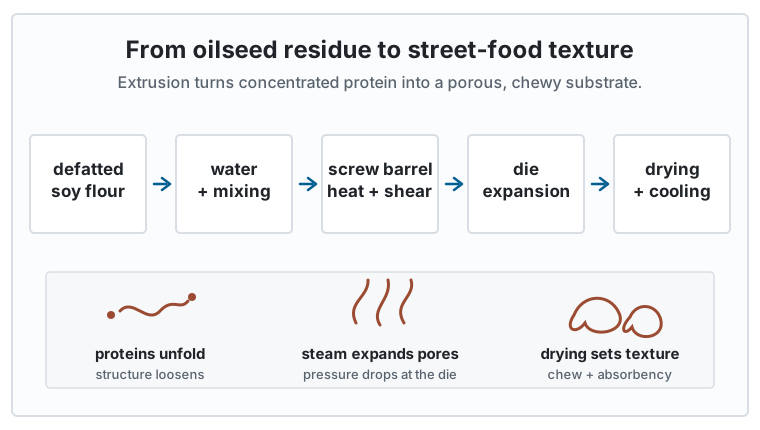
That cake opened the next stage. Pantnagar food scientists worked with Robert W. Nave’s Methodist-linked Nave Technical Institute and its Bareilly production venture to adapt American textured-soy technology for Indian use. An extruder-cooking plant converted the defatted cake into textured soybean protein. Sold as Nutri Nugget, the product was marketed as a substitute for paneer and meat for India’s vegetarian masses. Singh later calls it the “common people’s meat.”
The market moved fast. Entrepreneurs hired agricultural graduates to promote contract soybean cultivation around Aligarh and Bareilly. Other plants opened in Madhya Pradesh. Soon, Singh says, soybean production fell short of demand.
The food-processing science is worth lingering on because it explains why soy entered Indian food in such a peculiar form. Soybeans are roughly 40% protein and 20% oil. Crush out the oil and the remaining defatted meal is an extremely cheap concentrated protein. But concentrated protein is not yet food. Soy flour has taste, texture, and a tendency to interfere with whatever you put it into, which is why early soy products often had to be buried inside breads, pastas, and beverages.
Texturization solved the behavior problem. Under heat, pressure, moisture, and shear, defatted soy flour, concentrate, or isolate can be made chewy, porous, elastic, and shelf-stable: not meat exactly, but meat-adjacent in the ways that matter. Extrusion is basically industrial pressure-cooking with choreography: a moistened soy mixture is driven through a heated barrel; proteins denature and reorganize; pressure drops at the die; water flashes into steam; and the product expands into a fibrous sponge. Dry it, ship it, rehydrate it later.
Textured soy gives cooks chew, elasticity, and absorptive surface area. In a cuisine where flavor is often built in the tempering, marinade, sauce, or gravy, that kind of blankness is capacity.
And suddenly my mother-in-law’s soya chunks clicked into place. Being highly processed was not incidental; it was the point. They were a solution to the problem that whole soybeans had failed to solve. Soybeans were unfamiliar, slow, fuel-intensive, and texturally wrong; soya chunks were convenient, shelf-stable, fast enough, and structurally open to Indian cooking. They were almost an anti-bean: not something with a strong culinary identity of its own, but something designed to receive one.
Soya-walas
By the time I came back to soya chaap itself, I had mostly stopped expecting a clean origin story.
That was frustrating, but also clarifying. Soya chaap is street food, and street food rarely leaves behind one inventor, one date, or one first shop. More often there is a new ingredient, a familiar demand, and a lot of people trying things until something works.
In this case, the practical problem was wonderfully direct: how do you make industrial soy behave like food people already want? How do you make it hold together, take seasoning, survive heat, sit on a skewer, char at the edges, and feel like food rather than a utilitarian protein supplement?
The restaurant owner who catered our wedding gave me my favorite answer. He told me he learned to make soya chaap from roadside street-food vendors. He would get up at dawn to watch them work, ask questions, study the process, and they were happy to show him.
After Gandhi, ICAR, USAID, University of Illinois, USDA germplasm collections, plant breeders, oil mills, and extruder cookers, the dish still had to be learned by watching what someone did with their hands while dodging auto rickshaw traffic.
A massive R&D program trickling down to the soya-walas.
What I came away with was a chain of translation: seed libraries into fields, fields into mills, mills into textured protein, textured protein into street technique. Finally, it became something a vendor could season, skewer, char, sell, and teach someone else to make. I had gone looking for the beginning of a dish and found the infrastructure that made the dish possible.
That was the story I wanted the five lines to gesture toward. Soya chaap is not ancient, but that does not make it culturally empty. It is a modern material entering older grammars of heat, spice, smoke, and hospitality.
Agronomy becoming street food.
Sources and further reading
This essay draws most heavily on B. B. Singh’s “Success of Soybean in India: The Early Challenges and Pioneer Promoters”, which gives a detailed participant account of the Pantnagar soybean program, the Bragg and Hardee trials, yellow mosaic virus, seed viability problems, USDA germplasm screening, and the early processing push. For the broader soyfoods and textured-soy history, especially the Robert W. Nave / Nave Technical Institute / Bareilly / Nutri Nugget story, I relied on William Shurtleff and Akiko Aoyagi’s History of Soybeans and Soyfoods in South Asia / Indian Subcontinent and the related SoyInfoCenter chronology.
Madeline Fisher’s 2014 CSA News profile of B. B. Singh, “B.B. Singh and his quest to make Cowpea the Food Legume of the 21st Century”, is mainly about his later cowpea work, but it contains a useful sidebar on his role in transforming soybean from an Indian agricultural novelty into a major food crop, along with biographical context about his training, farmer-adoption philosophy, and relationship to Norman Borlaug.
For Gandhi’s soybean experiment, I used the “Soya Beans” chapter in Diet and Diet Reform, originally from Harijan in 1935, along with related Gandhi food-reform material. The discussion of the Green Revolution’s effect on pulses draws especially on J. G. Ryan and M. Asokan’s “Effect of Green Revolution in Wheat on Production of Pulses and Nutrients in India”. The charts use FAOSTAT data, accessed through Our World in Data, and the state-level soybean geography is informed by Meghavi Prashnani et al.’s “Towards food security: Exploring the spatio-temporal dynamics of soybean in India”. For contemporary processing details, I also consulted NIFTEM’s Soya Chunks Processing project profile.